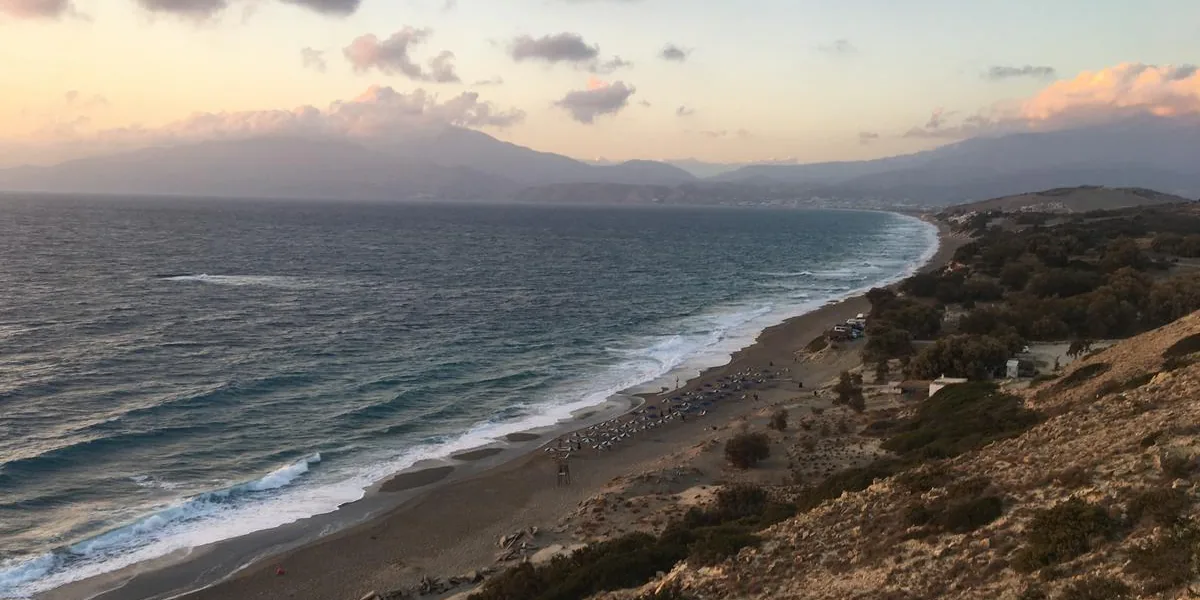
In Homer’s Odyssey a storm drives part of Menelaus’s fleet onto the coast of Crete, in a passage that names Gortyn and Phaistos, the two ancient cities of the plain below Kamilari. In another book Helen puts a drug into the wine to quiet sorrow, and Homer’s word for it gave Villa Nepenthe its name. And in the second half of the poem Odysseus keeps passing himself off as a Cretan.
Was Nolan’s Odyssey filmed in Crete?
No. Christopher Nolan’s film of the Odyssey reached cinemas in July 2026, and none of it was shot in Crete: the Greek scenes were filmed in Messinia, around Pylos and Methoni, and at Acrocorinth. The poem itself does come here.
A shipwreck near Phaistos
In book 3, old Nestor tells Telemachus what became of the Greek fleets on the way home from Troy. Menelaus was rounding Cape Malea when a storm split his fleet in two. Part of it was driven to Crete, and Homer describes the place: a smooth cliff that drops into the sea at the edge of Gortyn’s land, where the south wind pushes a great swell toward Phaistos and a small rock holds it back (lines 291 to 299). The ships broke on the reefs. The crews only just got ashore alive.
Gortyn and Phaistos are the two great ancient cities of the Messara plain. Phaistos stands on its hill ten minutes inland from Kamilari, and in Minoan times its harbour was at Kommos, the long beach west of the village. The passage ties the wreck to the south coast of Crete, in the country of these two cities. It does not give a spot: nobody can point to Homer’s cliff and his small rock with certainty. The sea that lies before Phaistos is the bay of Messara, which you see from our terrace.
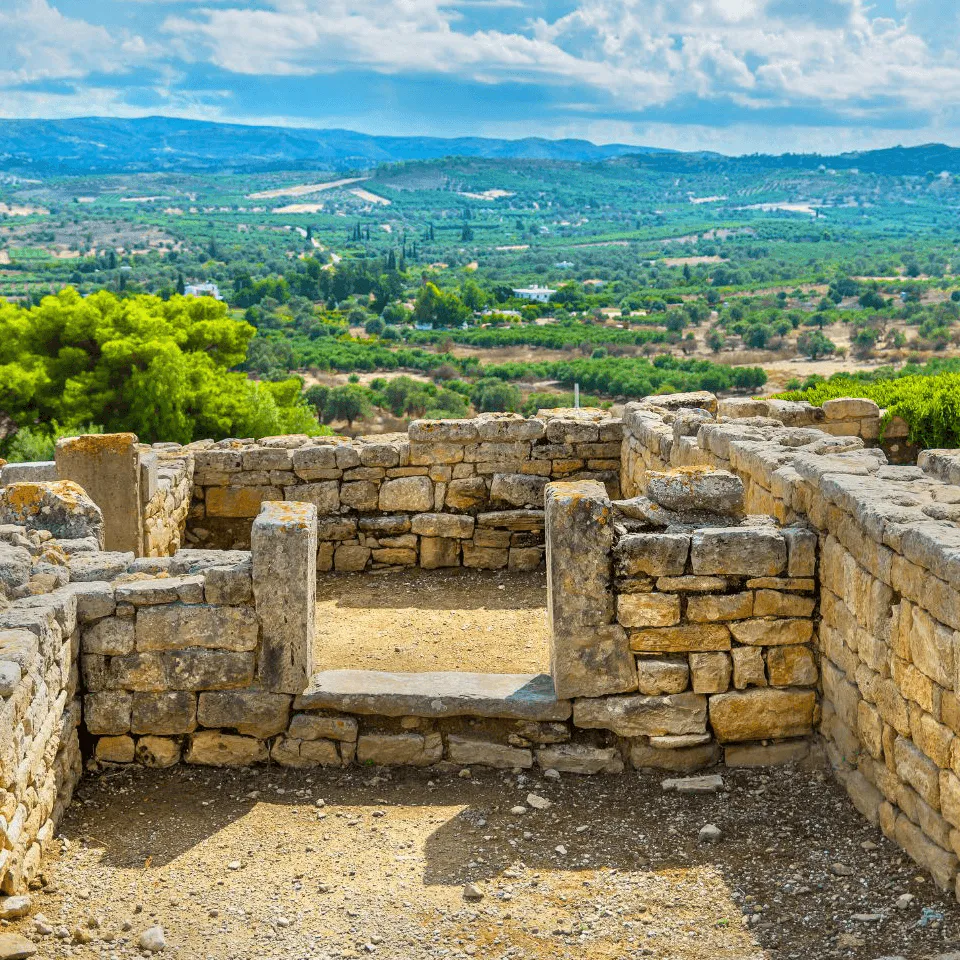
You can walk through the palace of Phaistos, and from its hill you look across the plain toward the bay. Kommos is not open to visitors: the excavated harbour town lies behind a fence just above the sand, and you see its walls from the path. Kommos is also one of the five beaches we would not miss.
Odysseus, the Cretan who never was
Crete keeps returning in the second half of the poem, in an odd way. Back on Ithaca in disguise, Odysseus has to explain who he is, and again and again he presents himself as a Cretan. To Athena he is a fugitive who killed the son of Idomeneus, the Cretan king (book 13). To the swineherd Eumaeus he is the son of a rich Cretan, a raider who fought at Troy (book 14). To Penelope he is Aethon, a grandson of Minos, and here Homer lets him describe the island: a fair and rich land in the middle of the wine-dark sea, with ninety cities and many languages, and Knossos, where Minos ruled (book 19, lines 172 to 179). Only with his father Laertes, in the last book, does he name a different home.
Crete gives these invented lives a believable background: a large island of ninety cities and many languages, whose king led eighty ships to Troy. Scholars call these passages the Cretan lies.
What does Nepenthe mean in the Odyssey?
Book 4 holds the scene the villa is named after. Telemachus has come to Sparta to ask Menelaus for news of his father. The talk turns to the war and to the friends who did not come home, and soon everyone at the table is in tears. Helen then slips a drug into the wine. Homer describes it as nepenthes, grief-banishing: it takes away sorrow and anger and makes a person forget every trouble. Whoever drank it, he says, would not shed a tear that day, whatever happened (lines 219 to 232).
The word is an adjective, built from ne, “not”, and penthos, “grief”. Later writers made a noun of it, nepenthe: a drink or drug that brings forgetfulness of sorrow. Helen was given the drug in Egypt, Homer adds, by a woman called Polydamna. That detail closes a circle: Egypt is where the storm carried Menelaus after it had wrecked the rest of his fleet on the coast of Crete.

It is a fitting name for a house made for the first evening of a holiday. The journey is behind you, the sun goes down over that same sea, and for a few hours nothing needs deciding. No drug is required, and the wine is optional.
Reading it here
If the film sent you back to the book, bring it. A week by the pool is long enough to read it, and two of its places are a short drive away: Phaistos, and the coast that the passage about the wreck describes. For the village itself, start with Welcome to Kamilari.